The Great Escape
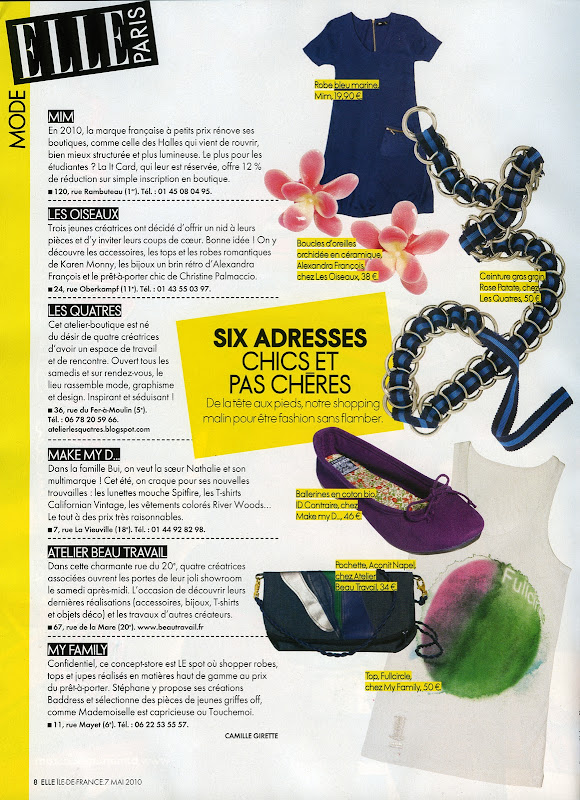
Sales Workshop The Four

of 3 to 13 June 2010
36 rue iron mill
75005, Paris Metro
Censier-Daubenton
Open from 11am to 19:30
Payment by check or cash
Opening party Thursday, June 3 to 18H.
Hope to see you soon!

"Hypocrisy is a vice in fashion (V 2)

"All you needed was to be hypocritical for you to complete in every respect" (V 2)
"That is my strong minds, who do not want to believe. " III, 5
" Your religion, what I see, is the arithmetic " (III, 1)
" - I think two and two are Four " (III, 1)
2 weights, two measures :
- Go, go, it's between heaven and I, and we disentangle well together, without thy meddling. (I, 2)
- I do not like the makers of remonstrance. (I, 2)
- What? You take good money for what I just said, and you think my mouth was in agreement with my heart? (V, 2)
- by pure political ploy useful, needed a face where I want to force me, to spare a father dint I need, and I take cover, the men's side (V, 2 )
- I do not mind, Sganarelle to confide thee, and I'm glad to have witnessed the depths of my soul and the real reasons which force me to do things. (V, 2)
- And why not? There are many others like me, who meddle in this business, and who use the same mask to deceive the world! (V, 2)
- Hypocrisy is a fashionable vice, and all fashionable vices pass for virtue. The character of a good man is best of all the characters that can play today, and the hypocritical profession has wonderful benefits. is an art of which fraud is always respected, and although the finds, one dare say anything against it. All the other vices of men are exposed to censorship, and everyone has the freedom to attack high, but hypocrisy is a vice prime , who in his hand, closes the mouth to everyone, and enjoys a rest sovereign impunity. It binds to force faces a close partnership with all the people away. (V, 2)
- I entertain low noise (V 2)
- I set myself up as censor the actions of others , judge evil of all the world , and will not have good opinion of me. "(v. 2)
- in this convenient excuse (V, 2)
- is the way to enjoy weaknesses of men, and that a wise mind adapts to the vices of his age . (V, 2)
*****
What to do with his "hubris" ?
to follow ...
"I recognize (and I refuse to recognize) in risky behavior" ...
correction duty of invention
www.tempoedialectique.blogspot.com
*****
"Oh poor girl you are, I pity your innocence, and I can not bear to see you run your misfortune." (II, 4)
What is a "nice person" ?
Read and reread The Princess of Cleves , Madame de La Fayette
then
Dangerous Liaisons, by Choderlos de Laclos
The Counterfeiters, André Gide
The Rapture Lol V. Steiner No, Marguerite Duras
Things , Georges Perec
www.tempoeroman.blogspot.com


Literature and commitment: self-portraits and portraits through ages and genres
novels, drama, poetry perspective cross argumentation and literary movements
(intertextuality and singularity of literary texts)
The moralists of the seventeenth century :
portraits of La Bruyere, La Fontaine's fables, the comic character of the comedies of Molière, the hubris Cornelian heroes and racinian
Theatre (comedy and tragedy): a "force field "
The tirade Dom Juan, Molière: V, 2 (p.76)
Tartuffe, Molière: I, 4
The twists and turns ...
TWISTED - TOR ...
Look for the words of this family lexical
Is there a relation between the TOWER and the word rhetoric?
What relationship do you see between Don Juan and the rhetoric? Who
distinguished "FINE" and "Geometry"?
Who opposed "fine mind" and / or "geometric" to "false spirit" ?
What relationship is there between a comedian and a hypocrite?
Do you see any difference?
Find the meaning of the words:
Captieux - pernicious - INSIDIOUS
Who is Don Juan? Who is
Tartuffe?
What relationship is there between Don Juan and Tartuffe?
Dom Juan, Tartuffe and Trissotin?
www.tempoetheatre.blogspot.com

What relationship do you see between Don Juan and the modern de-construction?
www.tempoedialectique.blogspot.com
Who spoke of "de- bending?
of ...
"The oblique self-talk"
of ...
"The objectivity of what we ourselves have developed"
and
Time Regained
www.tempoeroman.blogspot.com
"Art does not reproduce not the visible but makes visible " Klee
" Without the key wardrobe " ?
"The Strennas orphans" Rimbaud


"Art does not reproduce the visible but makes visible" Klee
Literature and commitment: self-portraits and portraits through the ages and genres
"Art is not a question of technique but of vision ', Proust, Time Regained
novels, drama, poetry perspective cross argumentation and literary movements
The moralists of the seventeenth century:
portraits of La Bruyere, La Fontaine's fables, the comic character of the comedies of Molière,
the hubris Cornelian heroes and racinian
Visions of man and the world "The Human Comedy" de Balzac:
Goriot , a novel by learning?
Poetry and commitment among the poets of the nineteenth century:
Baudelaire and Rimbaud, symbolist poets?
"Lover alternaive Camenae" , Virgil
(intertextuality and singularity of literary texts)
10 minutes of preparation (from a question on the selected text) + 10 minutes of oral
Papers presented:
The indirect argument: praise and blame (between caricature and satire)
Portrait of Arrias La Bruyere (p. 328)
Rat who withdrew from the world La Fontaine
Theatre (comedy and tragedy): a "force field "
The monologue Emilie I 1, Cinna, Corneille
Britannicus, Racine II, 6
The tirade Dom Juan , Molière: V, 2 (p.76)
Tartuffe, Molière: I, 4
Poetry and Commitment: functions of the poet and poetry
"L'Albatros Baudelaire
" The Sleeper in the Valley " Rimbaud
The novel and its characters (visions of man and the world) : Goriot of Balzac, a bildungsroman nineteenth century
The incipit: the first paragraph
The portrait of Madame Vauquer: of "This piece is in all its glory" to "And foreshadows the residents'
The tirade Mrs. Beauseant: of " - Well, Mr. Rastignac " to " We women, we have our battles to fight. "
The end of the novel: from "The two priests, the altar boy and clerk came"
Theatre (comedy and tragedy): a "field forces "
The tirade Dom Juan , Molière: V, 2 (p.76)
Tartuffe, Molière: I, 4
The monologue Emilie I, 1, Cinna, Corneille
Britannicus, Racine II, 6
Tuesday, May 25: 's tirade Dom Juan, Molière: V , 2 (p.76) read: I, 1, 2 and 3 + also provide Tartuffe and Goriot
Thursday, May 26: Tartuffe, Molière: I 4
Friday, May 28: revision scenes of tragedy of Corneille, Racine
=> risk: myths of Oedipus and Antigone
*****
The conglobation for a dramatic heuristic, hermeneutic, epistemological reading a literary text:
" everything is a sign, and every sign is message " Proust

" Night ungracious plenary where the dream stops flashing, keep me alive that I love " Rene Char
The flower of rhetoric: a evergreen " (Ronsard)
anthologies (or anthologies) poetic www.tempoepoesie.blogspot.com
" Blessed is he who can wing a strong
Charging into the light fields and serene
man whose thoughts, like larks,
Towards the morning sky take flight,
Who hovers over life and understands effortlessly
The language of flowers and silent things! "
Baudelaire " Elevation " , " Spleen and Ideal " , The Flowers of Evil
" What they say about the poet flowers " Rimbaud ( Poems 1870-1871)
I. Quid? Quis? Ubi? Quando? Quomodo?
Poetics generic and typological: 1st = first reading discovery hypothesis of reading
Intertextuality singularity and studied the text: what is there a generic identity and typological common with other texts of a literary movement or even different periods of literature? What stands there texts that have the same typological characteristics, generic, aesthetic?
2. Cur? Quibus auxiliis? Quomodo?
Poetics critical second reading discovery hypothesis = 2nd Reading
Intertextuality and singularity of the text studied: the text says? How and why this text has it been made? What are the main lines of convergence (conglobation effects)? How the study of artistic device makes it appear the lines of force in the composition of this text, a match between a form (in the etymological sense) and sense (direction)?
3. Cur? Quis? (3rd axis or conclusion)
Poetic criticism of an artist: what is the particular style of the artist? his artistic commitment? How this commitment manifests itself there in a particular aesthetic? What is his artistic universe? His poetic rest on such an ethic? This commitment is it matched with that of other artists of the same generation? What is special?
"Style (...) is the revelation, which would be impossible by means of direct and conscious of qualitative difference there in how the world appears to us, difference that if there was no art, would remain the eternal secret of each. "
Proust, Time Regained
"Art does not reproduce the visible but makes visible" Klee
"The question true art [...], was to find , to regroup, to inform us of this reality far from where we live, where we deviate more and more as and when it takes more thickness and impermeability conventional knowledge we substitute him, this reality that we are in danger of dying without having known and is simply our life ".
" Real life is missing " Rimbaud
" Through art we can only come from us, know what another sees of this universe is not the same as ours, and whose landscapes we would have remained as unknown as there may be in the moon. Thanks to the lart, instead of seeing one world, ours, we see it multiplied and as many as there are original artists, as we have at our disposal worlds, each more different than those roll in the infinite and which, after many centuries is extinguished the home which he originated, he was called Rembrandt or Vermeer, send us their unique rays . "
Proust, Time Regained
" Silence of the The work that speaks the word of the man who listens "
Roland Barthes, On Racine
as" evergreen " ...
www. tempoepoesie.blogspot.com
www.tempoestyle.blogspot.com
 Turner and its painters: exhibition at Grand Palais
 www.tempoepoesie.blogspot.com
 Who painted this "Seaport at Sunset" ?
Rimbaud, Illuminations
 Olivier Py - Director of The Odeon Theatre de L'Europe
  one foot close to my heart "
 Originally was the myth ...
"We do think per image. If you want to be a philosopher, write novels" , Albert Camus
Myth : legendary tale of origins that expresses the values of a society. Amplified by the collective imagination, he draws on legends carried by an oral tradition.
[low Mythus Latin, Greek mythos : story, tale]
"A myth is a history, a symbolic fable, simple and striking " , Denis de Rougemont
The myth is a fabulous story originally worn by an oral tradition. Often popular origin, he staged beings incarnating symbolic form of the forces of nature, aspects of the human condition (fable, legend, mythology). It usually contains a moral.
representation of facts or real characters distorted or amplified by the collective imagination the tradition. It often involves wonderful characters (gods, heroes * , animals fabulous, angels or demons).
* heroes: the etymological sense of "demigod"
Myth wants explanatory and founder of a social practice. He proposes as a metaphorical reading of the world and the society that sends (cosmogony and genesis: creation of the world, natural phenomena or man's relationship with God and society, the genesis of human society and its relations with other companies).
*****
"Music before all else" ...
Lyre lyricism
Tragedy ( tragos-ode )
Dionysus, Apollo, Calliope, Thalia, Nelpomène, Orpheus ... or chant that heals?
In ancient Greek music, song, dance and drama were inseparable.
They were associated with "medical art" .
What is the name of this god?
And why is it honored at Epidaurus?

Tragedy ( "Tragos" - "ode" ) or the song that heals: mimesis and catharsis
Aesculapius, the god of surgery and Medicine
He is the son of Coronis and Apollo (or the god of beauty selfish) => Ovid's Metamorphoses
From miraculous birth, trained by the centaur Chiron it becomes a good doctor.
He also teaches music and mathematics.
The hubris
He arrived a day late at the bedside of a young patient he had resurrected by the blood of Medusa to repair his fault.
He was chastised for having transformed the law of God (all men are mortal) and provoked the wrath of Hades (the god of the valley of the dead) because it would upset the balance => Prometheus Bound by Aeschylus
He is honored first in Epidaurus, Greece and throughout the the form of a serpent.

Opening of two sites at Epidaurus, at the beginning and at the height of Greek civilization:
the fourth century BC
Freud Introduction to Psychoanalysis
1. A medical center and religious (capacity 60 patients): miracles or miraculous therapies?
The percussion helped to heal "melancholy"
And the lyre "agitated" ...
2. An ancient theater (Or theater) with exceptional acoustics designed by the architect Polyclitus.